SDRs: 30 Second Sales Call Scripts Backed by Call Analytics
, 13 min read
SDRs: 30 Second Sales Call Scripts Backed by Call Analytics
Start with a 30-second direct opener that names the reason for the call and asks permission to continue. It consistently outperforms rambling introductions because it respects the prospect’s time. If you have a trigger event (funding, a new hire, a product launch), lead with that instead. If you have a referral, use it as your opener’s first line. Every script needs customizing to your product and practice before it sounds natural on a live call.
TL;DR:
- Using a personalized trigger-based opener improves connection rates after recent funding, leadership changes, or tech adjustments, with scripts lasting about 30 seconds.
- Replacing standard scripts with structured, practice-based frameworks increases natural delivery and reduces robotic sounding through regular rehearsal and iteration.
- Handling objections with acknowledgment, clarifying questions, and small commitments helps keep prospects engaged and turns resistance into qualifying questions.
- Multi-channel follow-up sequences with brief voicemails, emails, and social touches significantly boost callback rates over single contact attempts.
- Continually reviewing call metrics and leveraging conversation intelligence tools allow ongoing script improvements, resulting in higher meeting and conversion rates.
Table of Contents
- Which Sales Call Script Should You Use by Situation?
- Copy-Paste Sales Call Script Examples for Every Scenario
- How Do You Deliver a Script Without Sounding Robotic?
- Objection-Handling Scripts That Keep Prospects Talking
- Voicemail Scripts and the Follow-Up Cadence That Gets Callbacks
- How Do You Measure and Improve a Sales Call Script?
- Why Scripts Still Matter More Than Most Reps Think
- Put These Scripts to Work With Sales Pitch
- Sources
- FAQ
Which Sales Call Script Should You Use by Situation?
Not every call deserves the same opener. Matching the script family to the situation is what separates a rep who sounds prepared from one who sounds like they’re reading a call script template off a screen.
Here’s how to pick, and how much time each format takes:
- Cold outbound, no prior signal: Use a direct opener or problem-first opener. Budget 30 seconds for the opener, 2 to 3 minutes for discovery if they engage.
- Trigger event detected (funding round, leadership change, tech stack shift): Use a trigger-based opener. It converts better than a generic pitch because it proves you did homework, and it still fits inside 30 seconds.
- Warm referral available: Use a referral opener. Lead with the name immediately; this is the fastest opener to a “yes, go ahead.”
- Prospect already opened or clicked an email: Use a follow-up-after-email script. Reference the specific content, not just “following up.”
- Blocked by a gatekeeper: Use a short, confident gatekeeper script that treats the person as a colleague, not an obstacle.
- No answer: Use a voicemail script under 20 seconds, then move immediately into the follow-up cadence.
- Scheduled discovery or demo call: Use a structured opener that sets the agenda in the first 60 seconds, distinct from the cold-call opener.
The average cold call runs about 82 seconds in some 2026 practitioner data, which means your first line does most of the work. A 15 to 20 minute meeting ask only happens if the first 30 seconds earns it.
Copy-Paste Sales Call Script Examples for Every Scenario
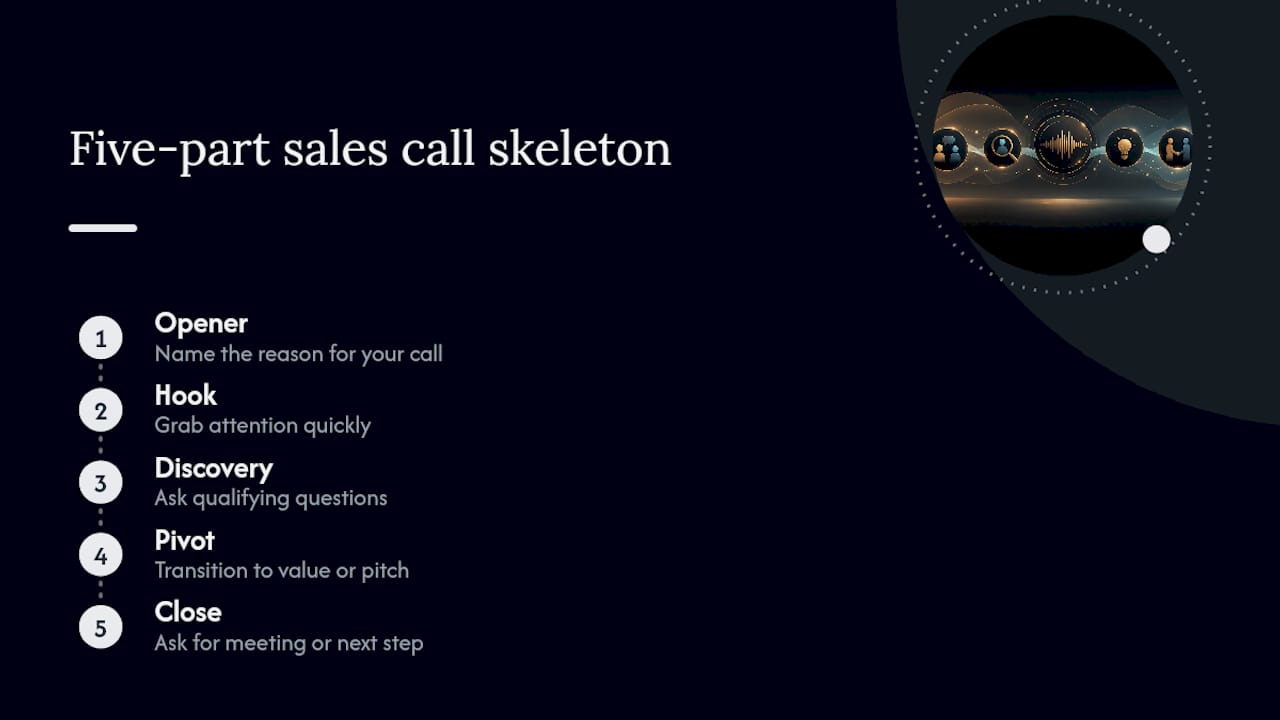
Every template below follows the same five-part skeleton: opener, hook, discovery, pivot, close. Naming the reason for your call inside the opener measurably increases meeting rates, so don’t skip that line even when you’re tempted to jump straight to the pitch.
1. The 30-second cold opener
Use this when you have no trigger and no referral, just a target account.
Quick swaps: Replace [similar company] with a name in their exact vertical. Replace [specific pain point] with the one problem your best customers had before they bought. Swap “30 seconds” for “20 seconds” if your average call length runs shorter.
2. The trigger-based opener
Use this after funding news, a leadership hire, or a public tech-stack change.
Quick swaps: Trigger source (funding announcement, job posting, press release), the department affected, and the outcome you deliver.
3. The referral opener
Use this whenever you have a name to drop.
4. The problem-first opener
Use this when you don’t have a trigger or referral but know the prospect’s category well.
5. Follow-up after an email
Use this when a prospect opened, clicked, or replied briefly to an earlier email.
6. The gatekeeper script
Use this to get past a receptionist or executive assistant without sounding evasive.
7. Voicemail script
Use this any time the call goes unanswered. Keep it under 20 seconds.
8. Discovery call opener
Use this on a scheduled call the prospect already agreed to.
9. Demo opener
Use this to set the agenda before screen-sharing anything.
Branching lines for common responses:
- “Now’s not a good time” — “Totally understand. Would [specific day/time] work better, or is this something that’s not a priority right now?”
- “Send me an email” — “Happy to. So I send something actually useful, what would you need to see to know if this is worth a conversation?”
- “We already have a solution” — “Good to know. Most of our current customers had something in place too. What’s working well with it, and what would you change if you could?”
How Do You Deliver a Script Without Sounding Robotic?
Treat your script as a skeleton, not a transcript. Reading a script word-for-word measurably reduces conversion, based on practitioner analysis of thousands of B2B calls. The fix is memorizing the structure, opener, hook, discovery, pivot, close, and letting the wording shift call to call.
Tonality matters most in the first 10 seconds. Slow down slightly on your name and company, then speed back up to a normal conversational pace. A rushed opener signals nerves; a flat, over-rehearsed one signals a script. Neither builds trust.
Ask for small permissions, not just the big meeting. “Do you have 30 seconds?” is a micro-commitment that makes the eventual meeting ask feel like a natural next step rather than a cold jump. And when you ask a discovery question, stop talking. Silence after a question feels uncomfortable for about three seconds, but filling it yourself trains prospects to give one-word answers instead of real ones.
Pro Tip: Record yourself running through a script out loud before your first live call of the day. If you stumble on the same line twice, that’s the line to rewrite, not the line to memorize harder.
Three practice drills build this faster than live calls alone:
- Read-aloud reps: Run the script out loud five times before your shift starts, varying your pacing each time.
- Roleplay with a peer: Have a colleague throw a random objection mid-script and practice pivoting without losing your place.
- Transcript review: Pull three of your own call transcripts weekly and mark exactly where prospects disengaged.
Non-native English speakers often over-rehearse pronunciation and under-rehearse pacing. Practicing sales English out loud with tools built for that gap closes it faster than repeating a script silently in your head.
Objection-Handling Scripts That Keep Prospects Talking
Every objection response should follow the same three-step pattern: acknowledge, question, micro-commitment. Skipping the acknowledgment and jumping straight to a rebuttal is what makes objection handling feel like arguing instead of conversation.
- “Not interested” — “Fair enough, most people say that before they know what I’m calling about. Can I ask, is it that you’re not looking, or that you haven’t heard enough yet?”
- “I don’t have time” — “Understood, I’ll keep this short. Is there a better time this week for 10 minutes, or should I just send a quick summary instead?”
- “Send me an email” — Ask one qualifying question that doubles as agenda-setting: “Happy to. What would need to be in it for you to actually want a follow-up call?” This approach outperforms a blind agreement because it forces the prospect to define what matters to them, which gives you a concrete reason to call back.
- “We already have a solution” — “Makes sense, most companies we work with did too. Out of curiosity, what made you choose them, and is there anything you wish worked differently?”
The goal isn’t winning the objection. It’s converting it into either a qualifying question or a specific next step. An objection you can’t turn into one of those two things usually means the prospect genuinely isn’t a fit, and that’s useful information too. Sales Pitch keeps a longer objection library if you want more phrasing options by category.
Voicemail Scripts and the Follow-Up Cadence That Gets Callbacks
A single voicemail rarely gets a callback on its own. It works as part of a sequence, combining calls, email, and LinkedIn touches outperforms any single channel, and small variations in each voicemail keep the sequence from sounding repetitive.
Three voicemail templates, each under 20 seconds:
- Direct drop: “Hi [Name], [Your Name] with [Company]. Calling about [specific reason]. I’ll follow up by email, but feel free to call back at [number].”
- Social proof: “Hi [Name], [Your Name] here. We just helped [similar company] with [specific result], thought it might be relevant to you. I’ll send details by email too.”
- Referral drop: “Hi [Name], [Referrer] suggested I reach out. Left a bit more detail in an email headed your way, but wanted to also introduce myself by phone.”
A 9 to 18 day cadence that pairs calls with other channels:
- Day 1: Call plus voicemail (direct drop), followed by a same-day intro email.
- Day 3: LinkedIn connection request referencing the call attempt.
- Day 6: Second call attempt with the social-proof voicemail, plus a follow-up email with a specific resource.
- Day 10: LinkedIn message with a relevant insight or article.
- Day 14: Third call attempt, referral voicemail if applicable.
- Day 18: Break-up email that closes the loop politely and leaves the door open.
Post-call emails should match the outcome: a confirmed meeting gets a calendar invite plus one line restating the agenda; an information request gets exactly what was asked for, no more; a break-up email says plainly that you’ll stop reaching out unless they’d like to reconnect later. Partner tools built for B2B content and outreach sequencing can help time LinkedIn touches to land between calls rather than all at once.
How Do You Measure and Improve a Sales Call Script?
Scripts that never get revised go stale fast. Build a simple rhythm: daily read-aloud drills, one weekly roleplay session, and a script update after every 10 to 20 calls once you’ve got enough data to spot a pattern.
Five metrics tell you whether a script is working: connect rate (dials that reach a live person), meeting rate (connects that convert to a booked meeting), talk to listen ratio (reps who talk more than 60% of the call typically book fewer meetings), objection frequency by type, and next-step conversion (meetings that lead to a second call or proposal).
Conversation intelligence platforms are becoming a standard part of script iteration in 2026. Transcript and call analytics let teams flag the exact phrases correlated with early hang-ups, then test a reworded version instead of guessing.
That shift, from gut-feel coaching to phrase-level data, is what separates teams that keep the same tired opener for two years from teams that quietly rewrite one line a month. If you want to understand how this tooling actually works before adopting it, conversation intelligence and revenue intelligence solve different problems, and knowing the difference saves you from buying the wrong one.
Why Scripts Still Matter More Than Most Reps Think
Scripts get a bad reputation because most people picture a rep reading dialogue off a card in a monotone. That’s not what a good script is. A good script is a decision tree you’ve internalized well enough to forget you’re using it. The reps who resist scripts entirely usually aren’t improvising brilliance, they’re repeating whatever half-formed opener worked once and hoping it works again.
Automation and AI tools haven’t made scripts less necessary. They’ve made bad scripts easier to spot and slower ones easier to fix. A rep who treats every call as a fresh improvisation has no baseline to measure against; a rep working from a tested skeleton can tell exactly which line stopped working and swap it out. That’s the whole value of treating a script as a framework instead of a script in the theatrical sense.
Sales Pitch builds its templates around that idea: structure first, wording second, and constant small revisions based on what prospects actually say back.
— Samuel
Put These Scripts to Work With Sales Pitch
Reading a template is the easy part. The harder part is customizing it to your product, your accent, and your prospect’s industry, then getting enough reps in to make it sound like you, not a printout. Effective sales scripts combine structure with practice and continual revision based on what prospects actually say back.
Start with the best cold call opening lines in English to sharpen your first 10 seconds, then work through the 30 B2B English vocabulary words every rep should know if precise phrasing on the fly is your bottleneck. If you’re deciding whether to lead with calls or email for a given segment, the cold calling versus cold emailing comparison breaks down when each wins. None of this is a hard sell, it’s the same practical, no-fluff resource library this article pulled from. Browse the Sales Pitch resource hub and pick the template that matches your next call.
Sources
- Otter
- Cold Calling Script That Actually Works (From 14,000+ Calls) — Alex Berman
- The Ultimate Cold Call Script: 12 Proven Templates — CallCombat
- Cold calling scripts: 21 examples, templates, and tips — Zendesk
FAQ
What is the best script for a sales call?
There’s no single best script, but a 30-second opener that states the reason for the call and asks permission to continue consistently books more meetings than a generic introduction. Match the family (direct, trigger-based, or referral) to what you actually know about the prospect.
How do you start a sales call script?
Open with your name, your company, and one clear reason for the call, then ask for a small commitment like “do you have 30 seconds?” Naming the reason for calling upfront is one of the more consistent drivers of higher meeting rates.
What are some good scripts for phone calls?
The strongest phone scripts follow five parts: opener, hook, discovery, pivot, and close, with the scripted portion kept to about 30 seconds so the rest of the call can flow naturally based on the prospect’s answers.
What should you say on a sales call?
Say why you’re calling, ask 2 to 3 open discovery questions about the prospect’s current situation, then pivot their stated pain point directly into the outcome you deliver before asking for a specific next step, like two meeting time options.