Win Replies With Follow Up Email Templates in 3–4 Touches
, 15 min read
Win Replies With Follow Up Email Templates in 3–4 Touches
The fastest way to improve reply rates is to use short, scenario-specific follow-up templates built around one clear ask, sent on a set cadence rather than whenever you remember. This guide covers templates for sales, job searches, networking, meetings, and proposals, plus the timing rules and subject lines that make each one land. Every template below is copy-ready: adjust the bracketed details, keep it under 90 words, and send.
TL;DR:
- Sending a follow-up within 2 to 3 business days with a clear, specific ask helps maintain a natural momentum without seeming impatient.
- Including a genuine value-add, such as new data or a relevant case study, in subsequent follow-ups increases the likelihood of a response.
- Personalizing by referencing a specific detail from prior interaction and offering an easy exit reduces friction and boosts reply rates.
- A final breakup email after 2 to 3 weeks with a low-pressure tone generally yields additional replies or confirms the lead is inactive.
- Most reply rates are captured within the third or fourth follow-up, making more than four touches often unnecessary unless triggered by new events.
Table of Contents
- What Makes a Follow Up Email Template Actually Work?
- When Should You Send a Follow Up Email?
- What Subject Line Gets Follow Up Emails Opened?
- Follow Up Email Templates by Scenario
- How Do You Personalize a Follow Up Without Overdoing It?
- What Does a Full Follow Up Sequence Look Like?
- Why Most Follow-Up Advice Misses the Real Problem
- Get More Templates and Sequences Built for Sales Teams
- Sources
- FAQ
What Makes a Follow Up Email Template Actually Work?
Every effective follow-up shares the same four-part skeleton, regardless of the scenario. Skip a part and the email either sounds pushy or gets ignored. Nail all four and you have something a busy recipient can process in ten seconds.
The four parts are:
- Subject line: specific enough that the recipient knows what’s inside before opening.
- Context anchor: one line reminding them who you are and why you’re writing, without retelling the whole backstory.
- Value-add: a new piece of information, resource, or angle that wasn’t in your last message.
- Single CTA and signoff: one clear, low-friction request, not a menu of options.
Keep the whole message under 80 to 90 words. That length constraint forces you to cut the throat-clearing and get to the point, and it respects that most follow-ups get read on a phone between meetings. Background research on outreach messaging consistently points to concise, single-ask emails outperforming longer, multi-question ones, largely because each additional question in an email adds a decision the recipient has to make before they can reply at all.
For the context anchor, reply in the original thread whenever one exists (“Following up on our call last Tuesday about…”) rather than starting fresh. If there’s no existing thread, or it’s been more than three or four weeks, a new subject line with a one-line reference works better than resurrecting a stale conversation.
Acceptable value-adds include a relevant case study, a shorter path to a decision (“I can also just send a one-pager if that’s easier to route internally”), a new data point, or a schedule offer with two specific times instead of “let me know when works.” Vague nudges like “just checking in” don’t count as value. They restate the ask without giving the reader a new reason to respond.
Pro Tip: Before sending, read your draft and ask: “What new thing am I giving them, and what’s the one thing I want them to do?” If you can’t answer both in one sentence each, rewrite before you send.
When Should You Send a Follow Up Email?
Timing decisions are usually the biggest lever in a follow-up sequence, more than wording. Send too soon and you look impatient. Wait too long and the context evaporates.
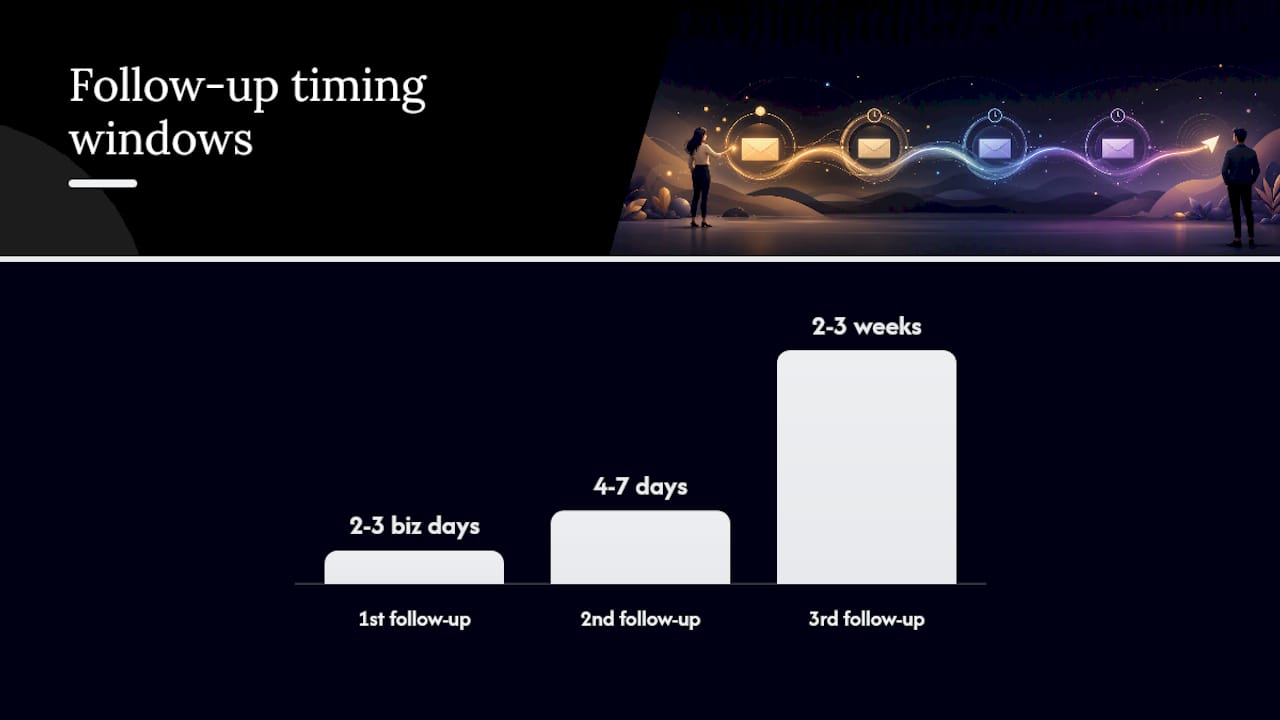
- First follow-up: 2 to 3 business days after the original email or meeting. This is a quick bump, not a full re-pitch. Reference the specific thing discussed and keep it to two or three sentences.
- Second follow-up: 4 to 7 days later. This one needs a genuine value-add: new information, a resource, or a different angle on the same ask. This is the touch where generic “circling back” language does the most damage.
- Third follow-up: 2 to 3 weeks out. By now the recipient has likely made a decision by inaction. This is where a soft breakup message performs better than another nudge.
- Final touch: the breakup email. One last message that removes pressure and asks whether to close the loop entirely.
Practitioner guides converge on a similar rhythm, with a bump at 2 to 3 business days, a value-add follow-up at 4 to 7 days, and a soft breakup around the two-to-three-week mark. Large template libraries analyzing outreach performance find that reply rates climb through the second and third touch, then flatten, with most of the value captured by the third or fourth message in a sequence.
Trigger events can reset this clock. A new budget cycle, a hiring announcement, a product launch on their end, or a mutual connection mentioning them are all legitimate reasons to reach out again outside the normal cadence, since you now have a real reason rather than a manufactured one. If email has gone quiet after three attempts, switching channels, a LinkedIn message or a phone call, often revives a stalled thread before you write the deal off. Either way, log the outcome and archive or close the record so your pipeline reflects reality instead of wishful thinking.
What Subject Line Gets Follow Up Emails Opened?
Subject lines succeed or fail on specificity. “Following up” tells the recipient nothing they didn’t already know from the sender’s name. A subject that names the topic, the ask, or the next step gives them a reason to open now instead of later.
Reply in the existing thread whenever a real prior conversation exists. If you’re starting fresh, patterns that consistently work include referencing the specific project or topic, leading with a data point or benefit, or naming a mutual connection. One caution: never fake a “Re:” prefix on a cold email where no thread exists. It might nudge opens in the short term, but it damages trust the moment the recipient realizes there was no prior email, and some spam filters flag manufactured thread continuity as a manipulation tactic.
Small wording changes make a measurable difference in how a subject line reads:
| Weak subject line | Stronger alternative | Why it works better |
|---|---|---|
| Following up | Quick question about [Project Name] | Names the topic instead of just the action |
| Checking in | 2 minutes on [specific ask]? | Sets a time expectation and a clear scope |
| Touching base | [Mutual Contact] suggested I reach out | Borrows credibility from a known name |
| Any update? | New pricing option for [Company] | Leads with a benefit, not a status check |
| Re: our conversation | Following up on [specific detail discussed] | Specific enough to jog memory without a fake thread |
Grammarly’s guidance on follow-up writing makes a similar case: swapping a vague line for a specific one increases the odds the recipient opens with intent rather than scrolling past.
Follow Up Email Templates by Scenario
Each template below follows the four-part structure: subject, context, value-add, one CTA. Adjust the bracketed sections and trim anything that doesn’t apply to your situation.
-
Sales follow-up after a demo or meeting Subject: Quick recap from our call Body: “Thanks for the time today, [Name]. Recapping the two things you flagged: [pain point] and [budget timing]. I put together a short one-pager on how [Company] solved something similar. Worth 15 minutes next week to walk through it?” Edit note: swap the recap details for whatever the prospect actually raised, not generic pain points.
-
Sales follow-up after no response Subject: New case study for [Industry] Body: “Hi [Name], wanted to share this since it’s close to what we discussed: [one-line result from a similar company]. Does Thursday at 2 PM or Friday at 10 AM work for a quick call?” Edit note: the value-add must be new, not a repeat of the first email’s pitch.
-
Job application follow-up Subject: Following up on [Job Title] application Body: “Hi [Hiring Manager], I applied for the [Job Title] role on [date] and wanted to confirm it came through. I’m still very interested, particularly given [specific detail about the team or project]. Happy to send anything else that’s useful.” Edit note: reference something specific from the job posting, not a general interest statement.
-
Interview thank-you and no-response follow-up Subject: Thank you, plus a quick follow-up Body: “Thank you for the conversation on [date], [Name]. I appreciated hearing about [specific project mentioned]. Checking in on timeline. Is there anything else useful for me to send while you decide?” Edit note: university career guidance recommends naming the role and interview date directly rather than a generic thank-you.
-
Networking follow-up Subject: Great meeting you at [Event] Body: “Good talking with you about [topic] at [Event]. I mentioned [resource or article], attaching it here. Would love to stay in touch. Open to a short call sometime next month?” Edit note: reference one specific thing from the conversation, not “great meeting you.”
-
Introduction-from-contact follow-up Subject: [Mutual Contact] connected us Body: “Hi [Name], [Mutual Contact] mentioned you’re working on [specific initiative]. I’ve helped a few similar teams with [related area]. Worth 15 minutes to see if it’s relevant?” Edit note: name the mutual contact in the subject line, not just the body.
-
Meeting recap and next steps Subject: Notes and next steps from today Body: “Recapping today’s call: we agreed [Name] would send [item] by [date], and I’ll follow up on [item]. Let me know if I missed anything.” Edit note: assign owners and dates explicitly so nothing gets lost between meetings.
-
Proposal or pricing follow-up Subject: Any questions on the proposal? Body: “Wanted to check whether the pricing outline made sense or if anything needs adjusting. Happy to walk through it live if that’s easier than email.” Edit note: offer a call as the easy out, not just “let me know.”
-
Soft breakup email Subject: Should I close this out? Body: “Haven’t heard back, so wanted to check where this stands. If timing’s off, no worries at all. Should I check back in a month, or is this not a fit right now?” Edit note: giving a specific alternative (“check back in 30 days”) performs better than an open-ended “let me know.”
-
Final breakup email Subject: Closing the loop Body: “Assuming the timing isn’t right and I won’t reach out again unless you’d like me to. If anything changes, I’m here. Wishing you luck with [project mentioned].” Edit note: this one should read as genuinely low-pressure, not a last-ditch sales pitch disguised as a goodbye.
How Do You Personalize a Follow Up Without Overdoing It?
Three quick edits separate a template that gets replies from one that gets ignored: a specific detail, a real value-add, and a closing that offers an easy out instead of demanding an answer.
- Add one specific detail from the last interaction: a phrase they used, a number they mentioned, a project name. It signals you were actually listening.
- Swap generic value for something concrete: a benchmark, a short case study, or a direct answer to a question they raised, instead of “just wanted to see if you had any thoughts.”
- Close with an easy out: “No worries if now isn’t the right time” costs you nothing and often gets a faster, more honest answer than silence would.
Tone matters as much as content. Acknowledge that the recipient is busy rather than implying they’ve been ignoring you. Avoid manufactured urgency (“This offer expires Friday”) when there’s no real deadline. And retire “just checking in” entirely. It’s the email equivalent of a shrug, containing no information and no reason to respond.
Pro Tip: Replace “just wanted to check in” with “wanted to share [specific thing] since it’s relevant to what we discussed.” Same intent, completely different read.
What Does a Full Follow Up Sequence Look Like?
A sequence is just your templates strung together on a calendar, with the ask sharpening each time the recipient stays quiet.
- Warm meeting sequence (someone you’ve already spoken with): Day 0, send the meeting recap. Day 3, quick bump referencing one open item. Day 10, value-add with a specific resource or case study tied to what they raised.
- Cold re-engagement sequence (no response yet): Day 0, initial email. Day 5, value-add with new information. Day 12, a different angle or resource. Day 21, soft breakup asking whether to close the loop.
- Post-proposal sequence: Day 0, send proposal. Day 3, confirm it arrived and offer to walk through it. Day 10, value-add such as a relevant reference or ROI note. Day 21 to 25, final breakup email.
Switch channels, a LinkedIn note or a call, after the second or third silent touch rather than the first; jumping too early can look scattered. If the breakup message gets a reply of any kind, even a “not now,” log it and pause the sequence rather than deleting the contact. If it gets nothing after the final touch, archive it. That’s not failure. It’s how you keep a pipeline honest instead of cluttered with dead leads that never say no.
Why Most Follow-Up Advice Misses the Real Problem
Most advice on follow-up emails focuses on tone: sound friendly, sound confident, don’t sound desperate. That’s not where the real failure happens. The real failure is structural. People send a second email that’s just a shorter version of the first one, with no new information and no easier ask than before. Of course it gets ignored. It’s not offering the recipient anything they didn’t already decide to pass on.
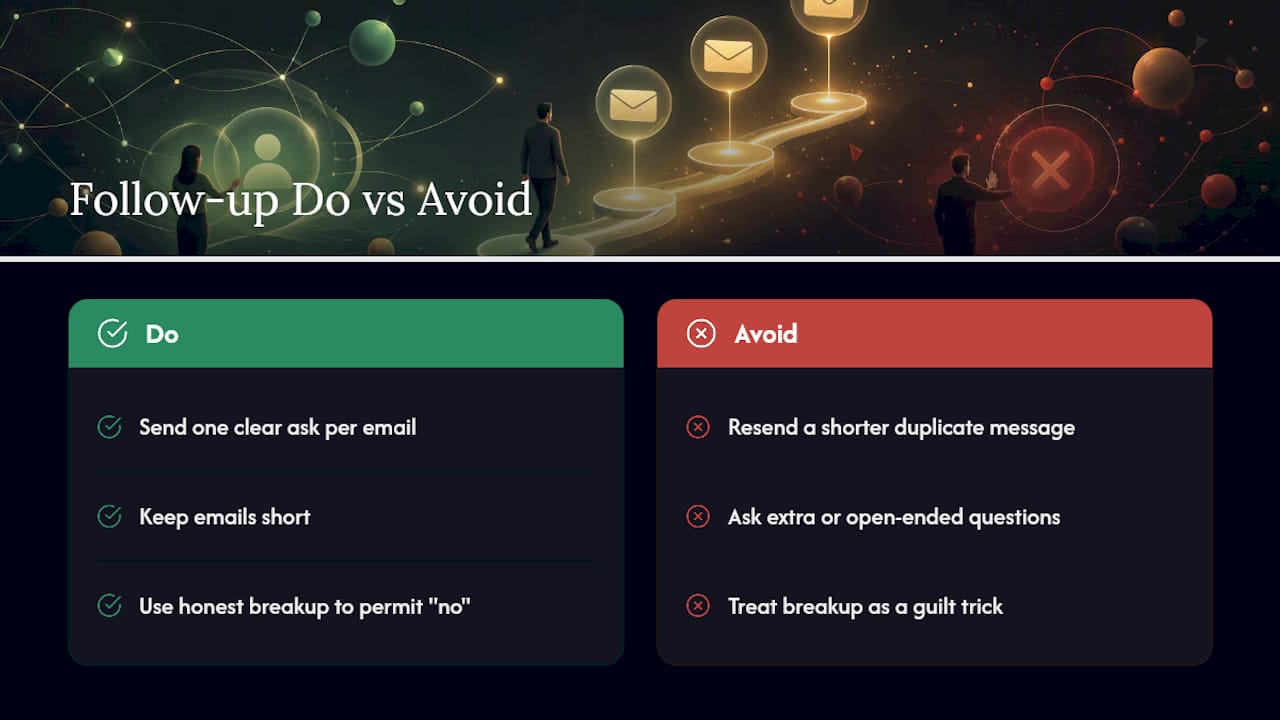
The one-ask rule gets treated as a nice-to-have when it should be treated as the whole game. Every extra question, every “or whatever works for you,” every open-ended “thoughts?” adds a decision the recipient has to make before they can reply. Cut the sequence down to one clear ask per email, and you’ll notice something: the emails get shorter, but the replies get faster, because you’ve removed the friction that was never about tone in the first place.
The other thing worth saying plainly: a breakup email is not a trick. Professionals sometimes treat it as a manipulation tactic, a way to guilt someone into responding. Used honestly, it does the opposite. It tells the recipient the pressure is off and gives them permission to say no. That permission is often exactly what gets a reply, because most silence isn’t rejection. It’s just a decision nobody wanted to have to type out.
— Samuel
Get More Templates and Sequences Built for Sales Teams
The templates above cover the core scenarios, but a real outreach cadence usually needs more variations than one article can hold, especially for cold sequences that need to work without any prior relationship to lean on. Usesalespitch’s 12 cold email templates in English extend this same structure into first-touch outreach, so your follow-ups and your openers use the same logic instead of feeling like two different playbooks.
The template page gives you copy-ready sequences you can drop straight into a CRM, subject-line variations already matched to the swap logic covered above, and phrasing built for reps writing in English as a second language. If you’re also weighing whether a stalled thread needs a channel switch, the site’s comparison of cold calling versus cold emailing breaks down when to make that call. Start by pulling the cold email template set and running it against your current pipeline this week.
Sources
- 12 Follow-up Email Templates for Every Work Situation
- Follow-Up Email Templates
- How to Follow Up on an Email: Templates + Timing | Sendspark
- How to write a follow-up email (Grammarly)
FAQ
How Do You Politely Write a Follow-Up Email?
Reference the last interaction in one line, add one new piece of value, and close with a single, specific, easy-to-answer request rather than an open-ended question.
How Do I Write a Follow-Up Email That Doesn’t Sound Pushy?
Keep it under 90 words, avoid phrases like “just checking in,” and offer the recipient an easy out, such as “no worries if now isn’t the right time.”
How Do I Professionally Say I’m Following Up?
Skip the word “following” entirely if you can. A line like “Wanted to share [new detail] since it connects to what we discussed” reads as helpful rather than a status check.
How Do You Say Follow Up in an Email Professionally?
Reference the specific prior context directly, for example “Circling back on the proposal I sent Tuesday,” rather than using a vague opener that doesn’t name what you’re referring to.
How Many Times Should You Follow Up Before Stopping?
Three to four touches typically capture most of the available reply rate, spaced at roughly 2 to 3 days, 4 to 7 days, and 2 to 3 weeks, ending with a soft breakup message.