2026 Cold Email Follow Up: 4–7 Touches That Turn Replies Into Meetings
, 18 min read
2026 Cold Email Follow Up: 4–7 Touches That Turn Replies Into Meetings
The best cold email follow-up sequence sends a fresh-angle message on day 3 or 4, a value-added touch on day 7 or 8, an objection handler by day 12 to 15, and a breakup email around day 15 to 21. The core rule behind every touch: it must add value or a new angle, never just restate the ask. Most replies (70 to 90%, according to a large cadence analysis) come after the opener, and Tuesday through Thursday mornings outperform Monday and Friday sends.
TL;DR:
- Sending follow-ups with new angles, proof, objections, and low-friction questions significantly increases reply rates, especially between touches two and five.
- Timing follow-ups on Tuesdays to Thursdays between 9 and 10 AM local time optimizes open and reply rates, while weekends and Fridays see notably lower engagement.
- Limiting sequences to four to seven touches and stopping immediately upon reply helps maintain deliverability and avoids damaging sender reputation.
- Personalization should focus on specific facts, trigger events, or peer results rather than generic industry comments, with each email serving a clear, distinct purpose.
- Automating reply detection, suppression, and CRM logging while testing subject lines, ask types, and personalization boosts sequence effectiveness by 15 to 30 percent.
Table of Contents
- How Should You Time Your Cold Email Follow-Up Sequence?
- How Many Follow-Up Emails Should You Send?
- What Should Each Follow-Up Email Say?
- Which Follow-Up Templates Should You Use?
- What Should You Do When a Prospect Replies?
- What Metrics Tell You a Follow-Up Sequence Is Working?
- What Should Your Follow-Up Tools Actually Do?
- Where to Find Tested Templates and Sequence Tools
- Why Structured Sequences Beat Volume in 2026
- Put the Sequence to Work With Ready-Made Templates
- Sources
- FAQ
How Should You Time Your Cold Email Follow-Up Sequence?
The cadence that consistently produces replies follows a graduated pattern: day 0 for the opener, day 3 to 4 for a reply-style bump, day 7 to 8 for a new angle or resource, day 12 to 15 for an objection touch, and a breakup between day 15 and 21. This structure comes from a convergence of 2026 outbound benchmarks, and it works because it respects how attention actually decays. A prospect who ignored your Tuesday email hasn’t necessarily rejected you. They forgot you exist by Thursday.
Widening the gaps as the sequence progresses matters as much as the initial spacing. Front-loading the cadence while interest is fresh, then stretching intervals out, keeps you visible without crossing into pestering territory. That’s the pattern top-performing sequences follow: tight early, loose later.
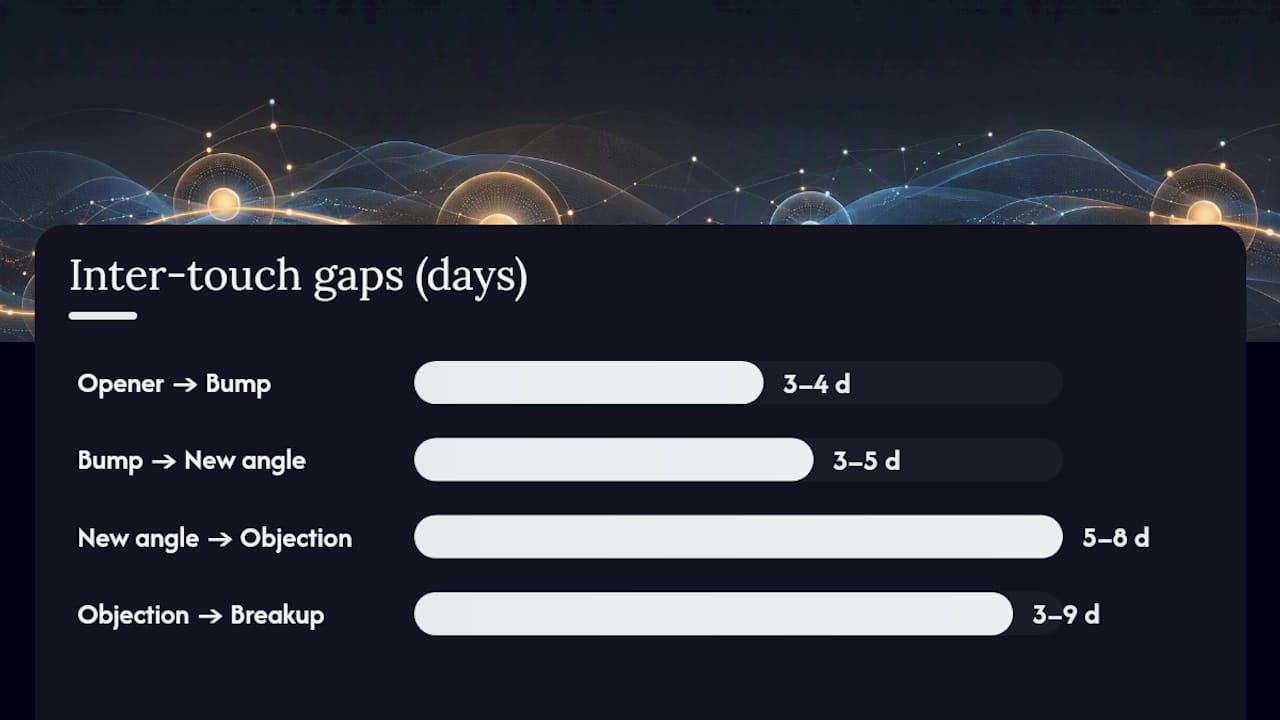
Not every prospect deserves the same clock. Senior executives and decision-makers with packed calendars respond better to a slower cadence. Wait 5 to 7 days between touches when you’re emailing a VP or C-suite contact, since their inboxes are triaged by assistants or filtered through delegation, and a rapid-fire sequence reads as desperate rather than persistent.
The one exception to graduated spacing: engagement signals. If a prospect opens your email three times in one day or clicks a link, compress your next touch to within 24 hours. That’s a real signal of active consideration, and research on cadence compression shows it produces a short-term lift when used selectively. Overuse it, though, and you’ll trigger spam complaints instead of replies.
Time zones deserve more attention than most sequences give them. A follow-up that lands at 6 AM in the prospect’s inbox gets buried under commute-hour email before they even open their laptop. Match send times to the recipient’s local morning, not yours.
Best sending windows for cold email follow-ups:
- Tuesday through Thursday, 9 to 10 AM local time, produces the most consistent open and reply rates
- Monday mornings are crowded with weekend backlog and get lower attention
- Friday afternoons see steep reply drop-off as people mentally check out for the weekend
- Avoid sending more than one touch per calendar week to the same prospect, even during compressed sequences
- Cap the full sequence at 4 to 7 touchpoints total, including the opener and the breakup
Deliverability risk climbs with aggressive cadences. Sending too many touches too fast increases spam complaints and unsubscribe rates, which then hurts your sender reputation for every future campaign. Watch your bounce rate, spam complaint rate, and reply rate together after each touch. If open rates suddenly drop mid-sequence, that’s often your first sign a mailbox provider is throttling your domain. A deliverability checkup at that point, rather than pushing harder with more volume, tends to fix the underlying problem faster.
How Many Follow-Up Emails Should You Send?
Send 3 to 5 follow-ups after your opener, for a total sequence of 4 to 7 touchpoints. That range balances reply lift against deliverability risk, and it’s the range most current benchmark data supports.
The statistic that should shape your whole sequence design: the majority of replies arrive on follow-ups #2 through #5, not the opener.
A cadence analysis across large outbound datasets found that 70 to 90% of all replies to a cold email sequence come from the follow-up touches, not the first send. If your team is only sending one or two emails per prospect and calling it a sequence, you’re leaving most of your possible replies on the table before the sequence even gets going.
That statistic changes how you should think about the opener. It’s not your best shot. It’s your first data point. The real work happens in touches 2 through 5, where you refine the angle based on whatever signal (or silence) the opener produced.
Rules for deciding when to stop the sequence:
- Stop immediately on any reply, positive or negative. A definitive “not interested” or “wrong person” ends the sequence.
- Continue through silence for the full planned sequence. Silence isn’t rejection; it’s the default state of a busy inbox.
- Compress timing only when you see multiple opens, link clicks, or other active engagement.
- After the breakup email, rest the prospect for 30 to 90 days before any re-engagement attempt.
- Never restart a full sequence on a prospect who explicitly opted out or marked your email as spam.
The breakup email deserves its own stopping logic. It should carry your smallest, lowest-friction ask, something like a single yes-or-no question rather than a meeting request. Breakup emails produce reply rates between 10% and 33% in operator studies, and a meaningful share of those replies convert to actual meetings, particularly when the earlier touches in the sequence delivered real value rather than just reminders.
The adaptive part of this rule set matters more than the fixed numbers. A sequence isn’t a script you run blindly to completion. It’s a decision tree: reply ends it, silence continues it, engagement compresses it, and the rest window protects your list from fatigue.
What Should Each Follow-Up Email Say?
Every follow-up in your sequence needs a distinct job. The opener introduces relevance. Touch 2 bumps with light proof. Touch 3 brings a new angle or resource. Touch 4 handles a likely objection. The breakup asks one small, final question. Assigning a specific job to each touch, rather than sending five variations of “just following up,” is what separates sequences that convert from sequences that get ignored.
Subject lines work differently depending on where you are in the sequence. For touches 2 and 3, reply within the same thread and keep the “Re:” prefix. That preserved context is what drives higher opens on early follow-ups, since the recipient recognizes the thread even if they never opened the original. Around touch 3 or 4, switching to a fresh subject line resets attention for prospects who’ve started ignoring the existing thread. Keep subject lines short and conversational: “quick follow-up,” “one more thought,” “closing the loop” all outperform anything that reads like a marketing blast.
Length discipline matters at every stage. Your opener should stay under 80 words. Touch 2, the reply-style bump, should run one or two lines, nothing more. Touch 3 can stretch to a short paragraph, roughly 50 to 125 words, since it’s carrying a new resource or angle that needs a little room to land. Longer than that, and you’re asking a cold prospect to do homework.
Personalization mechanics that actually move reply rates:
- Reference a verifiable fact about the company (a recent funding round, a product launch, a hire) rather than a generic industry observation.
- Cite a trigger event tied to timing, like a leadership change or a new office opening, that makes your outreach feel current.
- Use a peer metric or comparable customer result instead of vague claims about your product’s value.
- Avoid hollow personalization tricks like inserting the recipient’s first name into the subject line with no substance behind it.
Pro Tip: Skip any personalization that could apply to literally any company in the prospect’s industry. “I noticed you’re focused on growth” tells the reader nothing about you or them. A specific fact, even a small one, does more work than three generic compliments.
The job-per-touch discipline extends past copy structure into strategy. Sequences where each email carries a distinct purpose convert better than sequences where every touch repeats the same ask with slightly different wording. Prospects notice repetition fast, and a reminder with no new information reads as pressure rather than persistence.
Which Follow-Up Templates Should You Use?
Five template types cover nearly every scenario in a standard sequence: the reply-style bump, the new-angle touch, the value-drop, the objection-reframe, and the breakup. Each one maps to a specific position in the cadence described above.
-
The reply-style bump (touch 2, day 3 to 4). Keep this in-thread with the “Re:” subject intact. “Hi [Name], wanted to bump this in case it got buried. Happy to send over a quick example if useful.” The mechanic works because it costs the reader almost nothing to respond, and it signals you’re not going to disappear after one email.
-
The new-angle touch (touch 3, day 7 to 8). This is where you introduce information the opener didn’t have room for. “Hi [Name], following up with a different thought. [Peer company] saw [specific result] after solving [specific problem] similar to what I mentioned last week. Worth a 15-minute call to see if it applies to your setup?”
-
The value/resource template (mid-sequence). Attach or link something genuinely useful, a short guide, a relevant benchmark, a template. “Thought this might be useful regardless of whether we end up talking: [resource link]. If it’s relevant, happy to walk through how [peer company] applied it.”
-
The objection-reframe (touch 4, day 12 to 15). Address the most common reason prospects in this segment say no, before they say it. “Hi [Name], I imagine timing might be the issue, most teams tell me the same thing. If Q3 works better, I can follow up then instead. Just let me know.”
-
The breakup email (day 15 to 21). Small, final, low-friction. “Hi [Name], I’ll stop here unless this is useful. If it’s a flat no, one click tells me and I’ll close the file. If timing’s off, tell me when to check back.”
The variables worth swapping in every template are the company-specific fact, the metric or peer result, and the trigger event. What’s worth A/B testing across your sequence: subject line phrasing, the type of ask (soft question versus direct meeting request), and personalization depth (one specific detail versus two).
Keep every template mobile-readable. Most cold email opens happen on a phone screen, so short paragraphs, no dense blocks of text, and a clear single ask per email all matter more than they would in a longer sales document. A ready-made set of editable templates built around this exact sequence saves the trial-and-error most teams go through writing these from scratch.
What Should You Do When a Prospect Replies?
Every reply falls into one of five lanes, and each lane has a different next action. Getting this classification right, fast, is what turns replies into meetings instead of stalled threads.
| Reply type | What it looks like | Next action |
|---|---|---|
| Interested | Asks for more info or a call | Book a meeting within the same reply |
| Question or objection | Raises a concern or asks for clarification | Answer directly, then propose a next step |
| Not now | Requests a delay (“check back in Q3”) | Schedule a follow-up for the stated window |
| Referral or wrong person | Points you to someone else | Ask for an introduction or direct contact |
| Negative | Explicit no or opt-out request | Stop all sequences immediately, log as closed |
Speed matters as much as classification. Hot replies, the interested and question/objection lanes, answered within 15 minutes during business hours convert to meetings far more often than replies left sitting for hours. Warm replies (not now, referral) deserve a response within 2 hours. Everything else can wait until the same business day without meaningfully hurting conversion.
Operational rules that keep reply handling from leaking pipeline:
- Stop the sequence the moment any reply arrives, across every channel the prospect is enrolled in.
- Log the reply lane in your CRM immediately, not at end of day, so the next rep or automation step has accurate context.
- Route hot and warm replies to whoever owns the account, with a clear SLA and an escalation path if that person is unavailable.
- Never let an automated sequence keep sending after a human has replied. Automated reply detection that halts sequences is the baseline, not a nice extra.
What Metrics Tell You a Follow-Up Sequence Is Working?
Track five numbers across every sequence: open rate, reply rate, positive-reply-to-meeting conversion, unsubscribe and spam complaint rate, and reply speed. Reply rate and conversion to meetings matter more than open rate on their own, since a high open rate with low replies usually means your subject lines work but your copy doesn’t.
- Subject line variants: in-thread “Re:” versus a fresh subject at touch 3 or 4
- Ask type: a direct meeting request versus a small yes/no question
- Personalization depth: one specific fact versus two, and how much that changes reply rate
- Send-time windows: comparing Tuesday morning against Wednesday afternoon for the same segment
- Breakup phrasing: a hard close versus a soft “check back later” option
A follow-up sequence redesigned around distinct per-touch jobs, rather than generic reminders, produced a 15 to 30% lift in reply rate compared to sequences that just repeated the same ask. That’s the single most reliable lever in this whole playbook.
Roll out a winning variant once it beats the control by a meaningful margin across a full sequence cycle, not a single send. A subject line that wins on day one but shows no reply-rate difference after a full week of testing needs more data, not an immediate rollout.
What Should Your Follow-Up Tools Actually Do?
A sequencer earns its place in your stack by handling five things reliably: reply detection that halts sequences automatically, suppression lists that exclude bounced or opted-out contacts, throttled sending to protect domain reputation, two-way CRM sync, and built-in A/B test support.
Non-negotiable features for any sequencing tool:
- Automatic reply detection paired with a global stop, so no prospect gets a follow-up after they’ve already responded
- Suppression and exclusion list management that updates in real time, not on a delay
- Throttled, warmed sending domains rather than blasting the full list at once
- CRM sync that logs reply lanes and timestamps without manual entry
- A/B testing at the sequence level, not just the single-email level
Deliverability safety sits underneath all of this. List warming, address verification before the first send, and following sending domain best practices all protect the sender reputation your entire sequence depends on. Good tooling surfaces early deliverability warnings, dropping open rates, rising bounce rates, before they become a full domain reputation problem.
Automation should speed up routing and SLA compliance. It should never replace the human judgment required to read a reply correctly and respond with the right tone. Sellers who partner with AI tools are 3.7 times more likely to meet quota, according to Gartner, but that multiplier applies to reps using AI to assist their judgment, not reps who hand judgment over entirely.
Where to Find Tested Templates and Sequence Tools
This article’s sequence skeleton is built from cadence data across multiple 2026 outbound benchmarks, and the accompanying template library follows the same job-per-touch structure. Every template maps to a specific slot in the sequence: opener, bump, new angle, objection handler, breakup.
If you’re deciding between AI-assisted and fully human-written follow-ups, the sequence structure matters more than the writing method. AI can draft a competent bump email. It can’t decide which lane a reply belongs in or judge whether an objection needs a soft reframe or a direct answer.
This resource focuses specifically on B2B outreach tactics, deliverability mechanics, and templates that get edited and re-tested rather than used verbatim. That’s the standard worth holding any template library to: does it get adapted to your product, or copied and pasted as-is?
Why Structured Sequences Beat Volume in 2026
The trade-off nobody says out loud: sending more emails feels like progress, but it usually just burns deliverability while producing the same reply rate a well-timed, well-jobbed sequence gets in half the touches. Teams chasing volume treat every follow-up as a reminder. Teams that win treat every follow-up as a decision: what does this prospect need to hear next that they haven’t heard yet? That’s the whole game.
This week’s tactical takeaway: audit your current sequence and ask whether touch 3 says anything touch 1 didn’t. If it doesn’t, you don’t have a sequence. You have a nag.
— Samuel
Put the Sequence to Work With Ready-Made Templates
Building this exact cadence from scratch, five touches, each with a distinct job, personalized without sounding robotic, takes most reps several drafts before it converts. Usesalespitch’s 12 Cold Email Templates in English skip that draft cycle: each template maps directly to a slot in the day 0/4/8/15 skeleton, from the opener through the breakup.
The templates are editable, not locked copy. Swap in your own trigger event, peer metric, or company fact, then load them into whatever sequencer or CRM your team already runs. Pair them with the cold email deliverability guidance from earlier in this piece and you’ve got a sequence built on the same structure that’s driving the reply-rate lifts cited throughout this article. This resource is a starting point built to save you the first few weeks of trial and error, not a replacement for testing against your own list. Download the templates and adapt the first one to your next opener today.
Sources
- How to Follow Up on Cold Emails in 2026 (What to Send)
- Cold Email Follow-Up: 7 Templates + the Cadence That Gets Replies (2026)
- Gartner: Sellers who partner with AI are 3.7x more likely to meet quota
FAQ
How Do You Write a Follow-Up Email After a Cold Email?
Give it a distinct job, a new angle, a resource, or an objection handler, rather than repeating the original ask, and keep it shorter than the opener. Reply within the same thread for early touches, then switch to a fresh subject around touch 3 or 4.
How Many Times Should You Follow Up After a Cold Email?
Send 3 to 5 follow-ups after the opener, for 4 to 7 total touchpoints, since most replies arrive on follow-ups rather than the first send. Stop the moment you get a reply, and rest unresponsive prospects for 30 to 90 days after the breakup email.
What Is the 30/30/50 Rule for Cold Emails?
Definitions of this rule vary across sources, and the article’s research doesn’t confirm a single standardized version, so it’s worth treating any specific breakdown you see elsewhere with caution rather than as a fixed industry standard.
How Do You Follow Up on a Cold Networking Email?
Use the same job-per-touch logic: a light bump within the thread first, then a new angle or shared interest a week later, keeping each message short and low-pressure since networking asks carry less urgency than a sales pitch.
What Should You Do if a Prospect Never Replies to Any Follow-Up?
Send the breakup email around day 15 to 21 with one small, low-friction question, then rest the contact for 30 to 90 days before any re-engagement attempt with a genuinely new angle.
Recommended
Created with BabyLoveGrowth to rank on Google and in AI search