Stop Wasting Volume: B2B Account Based Outreach Wins $25,000+ Deals
, 14 min read
Account-based outreach means treating a target company, not an individual lead, as the unit of your prospecting work, coordinating touches across multiple stakeholders and channels toward one buying decision. It outperforms volume outbound once average contract value climbs past roughly $25,000 and the buying committee includes three or more people. If that describes your deals, the first move is simple: pick a moderate-sized pilot from your Tier 1 list and run it for about two months.
TL;DR:
- Account-based outreach is most effective for deals with an average contract value above $25,000 and a buying committee of three or more stakeholders.
- Prioritizing high-touch, multi-channel engagements for Tier 1 accounts significantly increases the chances of closing larger deals within a two-month pilot.
- Successful campaigns depend on detailed stakeholder mapping, trigger-based research, and sequencing carefully coordinated contact points without sounding spammy.
- Measure success by tracking account stages, such as engagement and multi-thread participation, rather than just reply or open rates.
- Use a minimal tech stack of data sources, validation tools, sequencing, and CRM to run effective outreach and ensure deliverability, scaling gradually after pilot validation.
Table of Contents
- What Is Account-Based Outreach and Why Does It Work?
- When Should You Use Account-Based Outreach, and How Do You Tier Accounts?
- How Do You Run an Account-Based Outreach Campaign Step by Step?
- How Do You Coordinate Channels Without Sounding Like Spam?
- What Tools Do You Actually Need to Run This?
- How Do You Measure Account-Based Outreach Success?
- Which Sales Pitch Resources Support This Playbook?
- Where Most Teams Get Account-Based Outreach Wrong
- Get Your Pilot Running with Sales Pitch’s Templates and Guides
- Sources
- FAQ
What Is Account-Based Outreach and Why Does It Work?
Volume outbound treats the contact as the unit of work. You email as many qualified people as possible and let reply rates sort the winners from the losers. Account-based outreach flips that math: the account is the unit, and a rep might spend a week researching, mapping, and sequencing touches to a single company before sending the first email.
The investment shift is real. A volume rep might touch 300 contacts a week. An account-based rep working a Tier 1 list might touch 15 to 20 accounts with the same effort, but each touch is built around a specific stakeholder’s role in the deal.
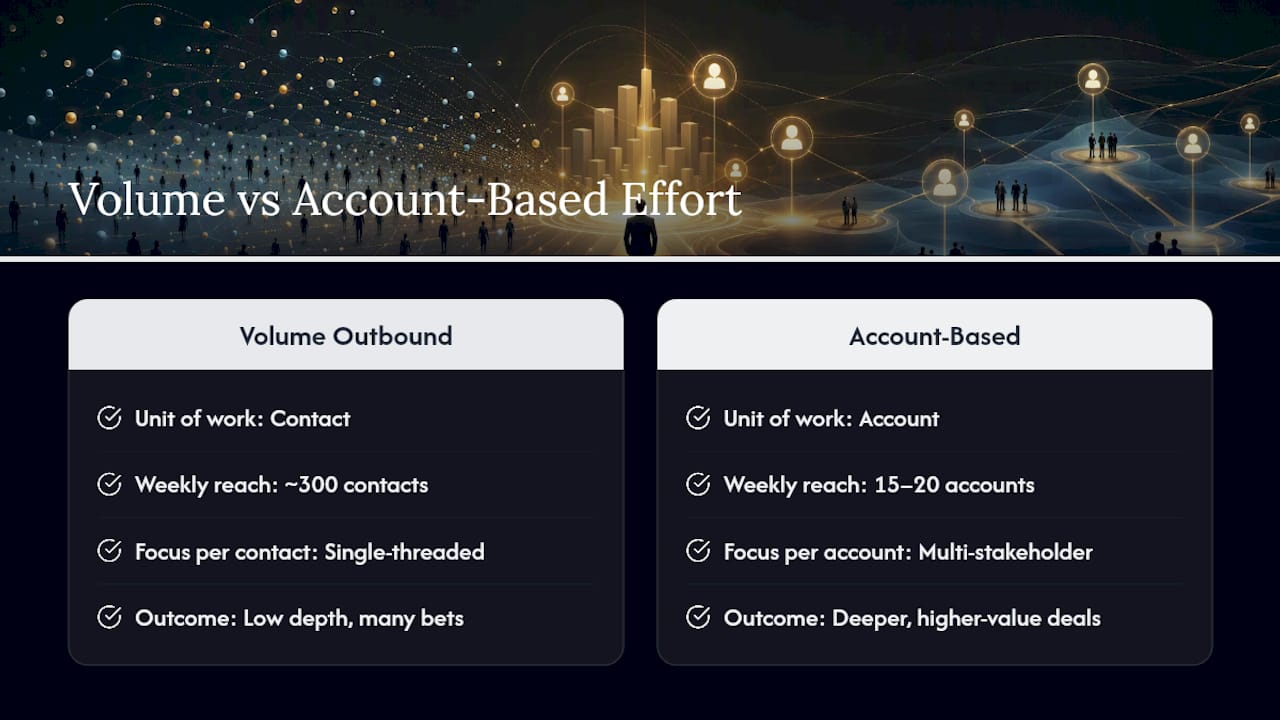
That trade pays off through multi-threading, reaching several stakeholders inside the same account instead of betting everything on one champion. Multi-threaded outreach creates internal conversations at the target company that a single-threaded email never triggers, which is the core mechanism behind account-based outbound performance. When a champion, a technical evaluator, and an economic buyer all hear a consistent message within the same two weeks, the deal moves faster because the internal debate is already happening.
The practical benefits show up in three places: higher conversion once an account engages, larger average deal sizes because you’re targeting accounts that can actually support them, and tighter alignment between sales and marketing because both teams are working from the same account list instead of separate funnels.
When Should You Use Account-Based Outreach, and How Do You Tier Accounts?
Account-based outreach isn’t the right model for every deal size. It earns its cost when average contract value sits above a certain threshold and the buying committee runs three or more stakeholders, since that’s when the research and multi-threading effort pays for itself. Below that threshold, volume outbound with light personalization usually wins on efficiency.
Before building a target list, check your addressable market size. If your ICP is so broad that “everyone could buy this” describes your account list, tighten it. Narrower criteria, industry, employee count, tech stack, funding stage, produce a shorter list your reps can actually research well, which matters more than list length.
Tiering determines how much attention each account gets:
- Tier 1 accounts get high-touch, multi-channel treatment: executive-to-executive intros, sometimes a physical gift, and dense cadences with daily internal check-ins.
- Tier 2 accounts get mid-touch treatment: coordinated email and LinkedIn sequences without the executive layer.
- Tier 3 accounts get low-touch nurture: automated sequences with light personalization, revisited quarterly.
This tiering structure is standard across modern ABM outbound strategy guidance. It keeps your best reps focused on the accounts most likely to close.
How Do You Run an Account-Based Outreach Campaign Step by Step?
This is the operational core of account-based outreach: the sequence that turns a Tier 1 list into booked meetings. Follow it in order.
-
Tighten your ICP and build a scoring rubric. Score each account on firmographic fit (industry, size, revenue) and behavioral signals (recent funding, leadership change, tech stack shift, job postings for roles your product supports). Outbound success is fundamentally selection driven: quality targeting and timing relevance matter more than message polish.
-
Build a trigger library. Keep a running list of signal types worth acting on: a new VP hire in the department you sell to, a funding announcement, a competitor churn signal, a product launch that creates a new pain point. Behavioral and intent signals meaningfully increase engagement rates when used to prioritize which accounts get outreach first.
-
Run the 10-minute research workflow before any outbound touch. Pull up the company’s LinkedIn page, recent news, and the target contact’s last three posts or role changes. Ten minutes is enough to write one specific line that proves you didn’t mass-blast the account. Skip this step and your “personalized” email reads exactly like the templated version underneath it.
-
Clean your list before you touch it. Run every email through a validator and hold your bounce rate under 2%. A bounce spike on day one of an account-based campaign damages sender reputation for every account in the batch, not just the bad addresses.
-
Build the stakeholder map. Identify the economic buyer (signs off on budget), the champion (feels the pain daily and will advocate internally), the technical evaluator (assesses fit and risk), and one or two influencers (adjacent teams affected by the decision). Practitioner playbooks consistently recommend mapping three to five stakeholders per account and capping active account load per rep to preserve research quality.
-
Contact the champion or end user first. They feel the problem most acutely and are the easiest entry point. Save the economic buyer for after you have a champion who can vouch for the conversation internally, and bring in the technical evaluator once there’s a real evaluation to run.
-
Escalate deliberately. If the champion goes quiet after two touches, loop in a peer or the technical evaluator with a different angle rather than repeating the same ask. Escalation to the economic buyer usually happens once the champion confirms budget authority sits elsewhere.
-
Sequence follow-ups with a hard stop. Run five to seven touches across three weeks. If the account shows zero engagement, pause outreach for 8 to 12 weeks before recycling it back into an active sequence. Recycling too early just trains the account to ignore you.
A coordinated account-based prospecting workflow, the kind Outreach’s own support documentation describes, stages this whole process so reps and managers can see exactly where each account sits without guessing.
Pro Tip: Keep a one-line “why now” hypothesis for every account before the first send. If you can’t articulate why this account needs to act this quarter, the personalization you add later won’t fix that gap.
Your templates don’t need to be complicated to work. A short example structure for the first champion touch: reference the specific trigger you found in research, state the relevant outcome in one sentence, and ask a low-commitment question rather than pitching a meeting outright. Sales Pitch’s cold email template collection has ready structures you can adapt to this exact first-touch pattern.
How Do You Coordinate Channels Without Sounding Like Spam?
Each channel plays a distinct role instead of duplicating the same message. Email is the anchor, it’s where the detailed case gets made and where a stakeholder can forward the conversation internally. LinkedIn builds recognition; a comment or connection request before the email lands means your name isn’t a cold surprise. Phone calls surface intel you can’t get any other way, and a well-placed voicemail referencing something specific often gets a callback that an email chain wouldn’t.
A workable sequence for a Tier 1 account over three weeks looks like this:
- Day 1: LinkedIn connection request, no pitch
- Day 3: Email 1, referencing the trigger from your research
- Day 5: LinkedIn comment on a recent post
- Day 8: Phone call, voicemail if no answer
- Day 11: Email 2, different angle, same specific hook
- Day 15: Phone call attempt two
Never stack more than one direct ask in a single day across channels. An email pitch and a phone pitch on the same day reads as pressure, not persistence.
Signal-triggered personalization doesn’t require a research team. A workable formula is: trigger + specific consequence + low-commitment question. “Saw you just opened a Denver office. That usually means onboarding process gaps for the first 90 days. Worth a quick look at how [peer company] handled that?” Personalization built around real intent signals like this consistently increases conversion and deal value, and firms that execute it well see outsized revenue impact compared to those that personalize only the greeting line, according to McKinsey’s research on personalization.
Pro Tip: If two reps are touching the same account (SDR and AE, or sales and marketing), share a single tracker so nobody sends a competing message the same week. Cross-channel coordination breaks down fastest when two people think they own the account alone.
What Tools Do You Actually Need to Run This?
You don’t need an enterprise platform to start. The minimum viable stack covers four jobs: a lead source for account and contact data, an email validator to protect deliverability, a sequencer or CRM sequence feature to schedule multi-channel touches, and a CRM to track account-stage progression.
Before scaling past your pilot, run these checks:
- Keep bounce rate under 2%; anything higher signals a data quality problem, not bad luck.
- Test a new sequence or template on a seed list of 20 to 30 accounts before rolling it out to the full Tier 1 list.
- A/B one variable at a time (subject line, first-line hook, send day) so you know what actually moved the needle.
- Hold off on intent data platforms or full orchestration suites until your manual pilot proves the motion works. Buying complexity before proving the process just adds another tool nobody adopts.
If you’re deciding between running sequences natively in your CRM or adding a dedicated sales engagement tool, the trade-offs are worth weighing before you commit budget. And whichever sequencer you pick, your deliverability setup matters more than the platform choice itself.
How Do You Measure Account-Based Outreach Success?
Individual contact metrics (opens, one-off replies) don’t tell you whether an account is actually moving toward a deal. Track accounts through defined stages instead: Targeted → Engaged → Meeting Booked → Opportunity. An account only counts as “Engaged” once more than one stakeholder has responded or taken a meaningful action, not just opened an email.
Leading indicators worth watching weekly:
- Engaged account rate: percentage of targeted accounts with real stakeholder response
- Multi-thread rate: percentage of engaged accounts with two or more stakeholders participating
- Time-to-first-engagement: days from first touch to first genuine response
Set benchmarks by tier rather than using one blended number. Tier 1 accounts should show a higher engaged rate given the resource investment; Tier 3 accounts will lag but at a fraction of the cost per account. This staged approach to measuring account progression rather than individual contact activity is what separates account-based reporting from a standard outbound dashboard.
Report weekly on stage movement, not raw activity volume. Revenue stakeholders care about how many accounts moved from Engaged to Meeting Booked this week, not how many emails went out.
Which Sales Pitch Resources Support This Playbook?
Sales Pitch’s template library gives you a starting point for the first-touch and follow-up emails in your cadence, and the site’s deliverability guidance covers the sender reputation checks your pilot needs before scaling past 50 accounts.
Run any new template on a small batch first, 20 to 30 sends, and watch bounce and reply rates before rolling it to your full Tier 1 list. If you’re comparing sequencing tools for the pilot itself, Sales Pitch’s platform comparisons walk through the practical trade-offs between the major options.
Where Most Teams Get Account-Based Outreach Wrong
The most common mistake isn’t a lack of personalization. It’s skipping stakeholder mapping and treating the champion’s engagement as the whole deal, then wondering why it stalls at “interested but no budget conversation.” The second mistake is running too many accounts per rep, which kills research quality. The third is measuring reply rate instead of account progression.
During a pilot, optimize for engaged accounts and multi-thread rate before anything else. Standardize the 10-minute research workflow across every rep before you scale headcount on the motion.
— Samuel
Get Your Pilot Running with Sales Pitch’s Templates and Guides
Building an account-based outreach motion from scratch means writing first-touch emails, follow-up sequences, and voicemail scripts for every tier, which eats weeks you don’t have during a pilot. There are practical, ready-to-adapt templates and deliverability guidance built specifically for B2B reps running real cadences, not generic marketing copy repackaged for sales.
Start with the cold email template pack to build your first-touch and follow-up sequences for Tier 1 accounts, then check your sending setup against the deliverability guide before you push past a seed list. If your pilot involves calls alongside email, the cold calling versus cold emailing comparison will help you decide where to weight your effort by tier. Browse the full Sales Pitch resource library for templates and guides that map to every step in this playbook.
Sources
Playbook mechanics draw on Outreach’s account-based prospecting workflow, stakeholder mapping guidance from AFF Lab, tiering structure from Abmatic AI, and account-stage measurement from Astra GTM. Personalization ROI figures come from Gartner and McKinsey. Content coordination approaches for measuring engagement across channels are covered in Plexo’s content engine guide.
- Impact of personalization — Gartner
- Account-Based Prospecting Playbook — AFF Lab
- State of Personalization report — Segment
FAQ
What Is the 3x3x3 Rule in Account-Based Marketing?
The 3x3x3 rule refers to targeting 3 accounts, mapping 3 stakeholders per account, and running 3 coordinated touches before evaluating engagement. It’s a simplified planning heuristic for reps new to account-based outreach who need a manageable starting scope rather than a rigid formula every team follows.
What Is an Example of Account-Based Outreach in Practice?
A practical example: a rep identifies a Tier 1 account that just raised a funding round, maps the economic buyer, champion, and technical evaluator, then runs a coordinated three-week sequence combining email, LinkedIn, and phone touches referencing that funding trigger. The goal is booking a meeting with at least two stakeholders engaged, not just one warm reply.
What’s the Difference Between Go-to-Market Strategy and ABM?
Go-to-market strategy covers your overall approach to reaching and winning customers, including pricing, positioning, and channel choices. Account-based marketing is one tactic within that strategy, specifically targeting named high-value accounts with coordinated, personalized campaigns rather than broad-market messaging.
What Are the Three Types of Account-Based Marketing?
The three common types are strategic ABM (one-to-one, heavily customized campaigns for a handful of top accounts), ABM lite (one-to-few, grouped by shared traits), and programmatic ABM (one-to-many, automated but still account-targeted). Account-based outreach usually sits inside strategic or ABM lite tiers, since it requires stakeholder-level personalization that programmatic ABM doesn’t attempt.
How Long Should an Account-Based Outreach Pilot Run?
An eight-week pilot with 10 to 50 Tier 1 accounts gives enough time to run a full sequence, measure engaged account rate, and decide whether to scale. Accounts showing zero response by the end should move into the 8 to 12 week recycle pause rather than getting immediate re-outreach.